

Product strategy
Proposed consolidating Lounge and Fast Track into a single Services tab for scalability. The proposal was approved and is reflected in the final design.
Consolidated four disconnected purchase paths

Role
Product Design Lead
Design QA
Collaborators
CTO
4 Engineers
1 PM
Timeline
Feb – April 2026
Scope
Mobile Product Design
E-commerce
Product Strategy
Data and Voice shipping in Q2. Services (Lounge pass and Fast track) to follow.
Impact
35% of sessions were already seeking non-Data products with no path to purchase them. Voice, Lounge, and Fast Track are now accessible as standalone tabs in a single destination for the first time. Post-launch conversion and cross-sell data to follow.
Overview
Jetpac started as a data eSIM app. As the company expanded into Voice, Lounge, and Fast Track, these were layered onto the existing structure rather than built into it. The app still reflected a single-product company.
The navigation restructure gave every product an entry point, covered in a separate case study. This one covers what customers find when they get there.
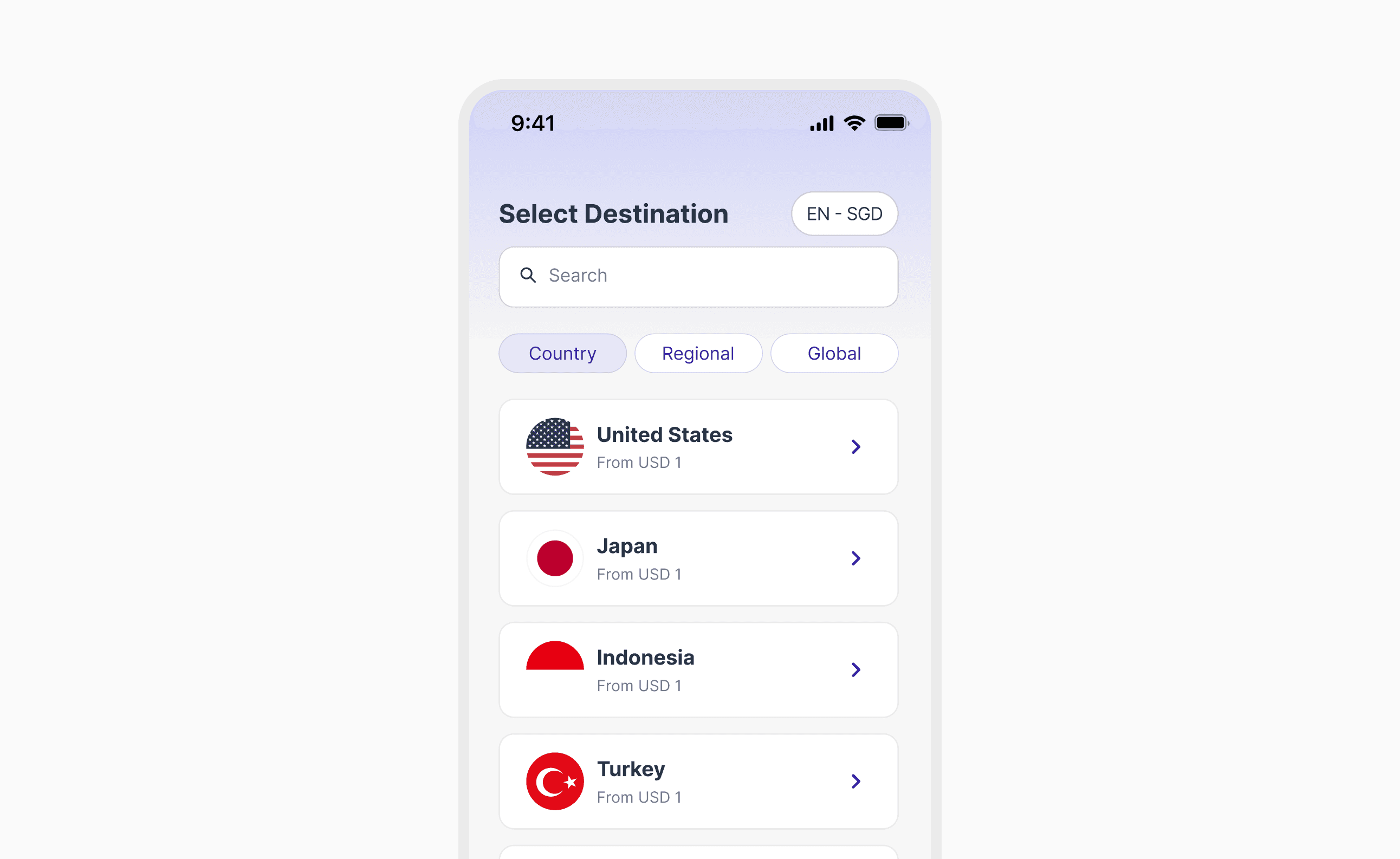
Original packs page
Contributions
Problem
The most-visited section in the app, Packs, only sells eSIMs. Whereas a third of users were navigating elsewhere for Voice, Lounge, and Fast Track across disconnected tabs and were treated as add-ons. I identified that the structure was limiting the discovery of non-Data products.
Goal
User goals
Travellers can find and access any Jetpac product, without having to navigate across separate tabs.
Business goals
Keep eSIM as the primary revenue driver while giving Voice, Lounge, and Fast Track a standalone purchase path, no data pack required.
Process
I went through three structural iterations. Aligned with the redesigned information architecture, the third and chosen structure grouped Lounge and Fast Track into one Services tab, solving both problems.
Split into Data Packs and Add-ons, which framed everything else as secondary

Four separate tabs, flagged by the APM and CTO as unscalable.

Lounge and Fast Track folded into one Services tab

Popular destinations drive most data sales, so I proposed to add a popular section before customers see all the packs in alphabetical order. After trying featured cards and heavier labels, popular packs landed as a light section that leads the list without breaking its scan.

Originally, Lounge and Fast Track passes were purchased by region. My initial proposal kept this structure, but after alignment with the PM, we explored alternatives. Proposal 2 still created friction, requiring users to take multiple steps to check lounge coverage. Proposal 3 shifted to an airport-based approach and surfaced lounge availability earlier in the journey.
Chosen direction: Proposal 3 was selected as it reduced friction and made lounge coverage easier to understand before purchase.
Solution
Each product gets a dedicated tab, so Voice and Services are no longer buried as data pack add-ons

Final version

Search scoped to Data destinations. Results filter in real time as you type, covering Country, Regional, and Global packs in one view.
Voice's small catalogue meant that the purchase flow could stay on one screen. Tap a pack, adjust quantity up to 10, and add to cart without leaving.
Lounge access searched and purchased by airport. Select an airport to see available lounges, with lounge count shown upfront so travellers know what's available before they tap.
Learnings